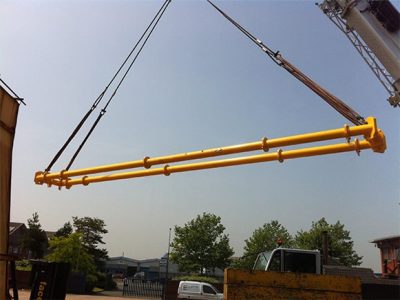
Spreader Frames & Lifting Frames
CMOD® and TriMOD Spreader Frames
Spreader Frames and Lifting Frames are recommended for loads that have more than two lifting points; they can also be the ideal lifting equipment when headroom is limited. Modulift offer several types of Spreader Frames and Lifting Frames for Multi-Point Lifts.
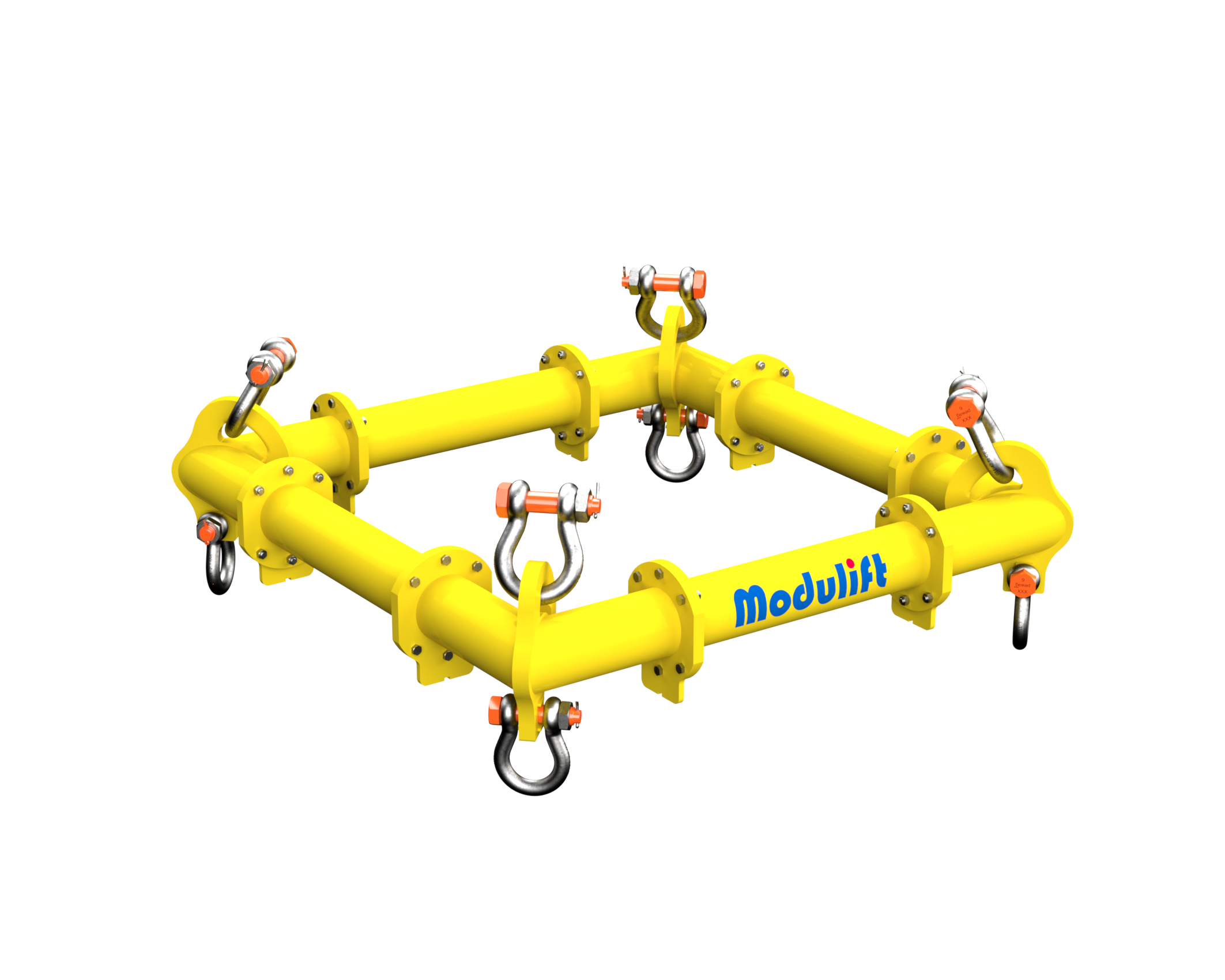
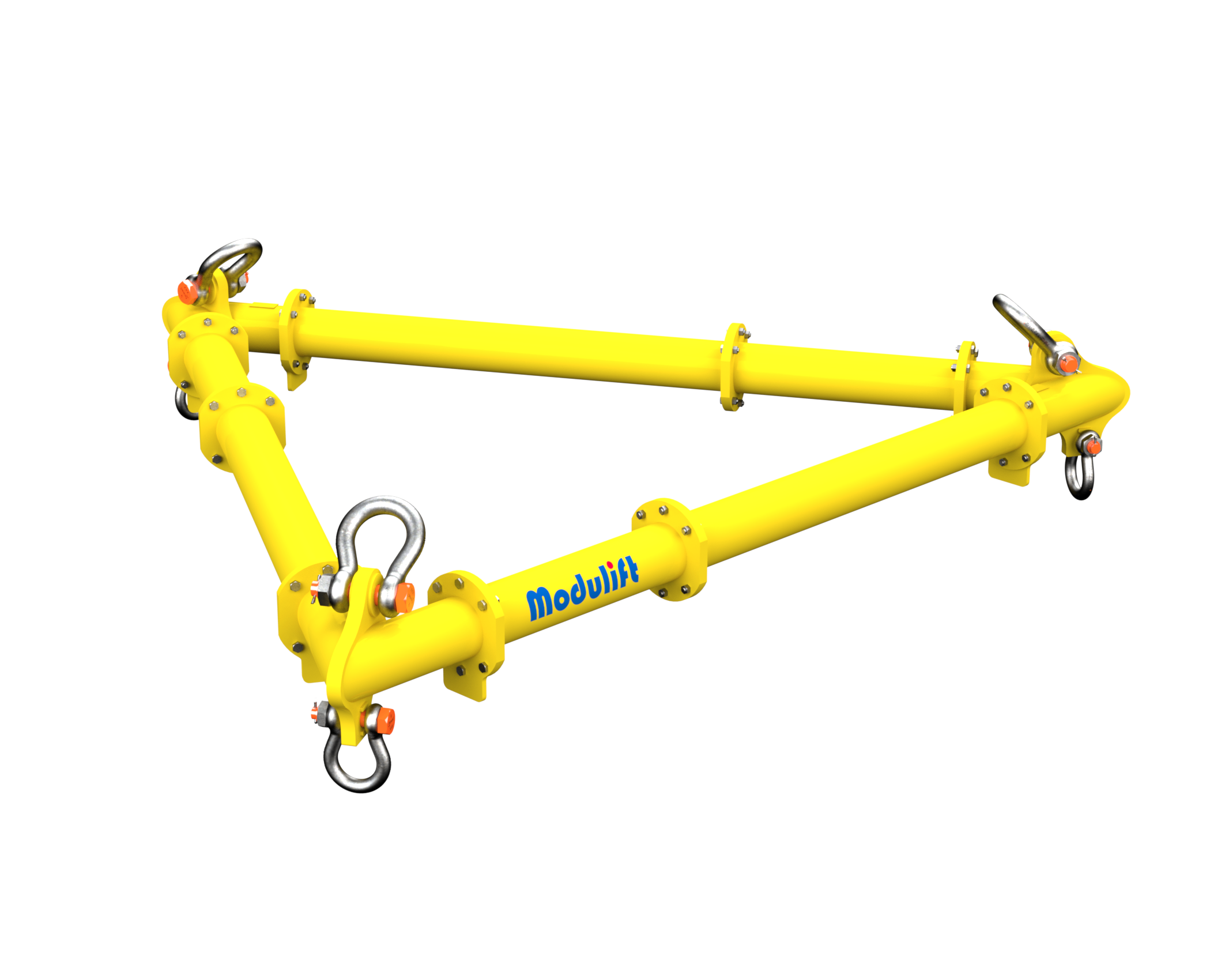
Modulift’s CMOD® and TriMOD Spreader Frames are a convenient, cost-effective method to lift circular or multi-point loads.
They are incredibly versatile – if you already have MOD® struts, you can reuse these with the corner units to make a 3-point TriMOD or 4-point CMOD®. Combine with T-Pieces to make a 6- or 8-point CMOD® Spreader Frame.

TriMOD compatible with MOD 6 – MOD 110, span width from 0.5m – 18m, WLL from 9.7t – 165t
CMOD® 4, 6 and 8-point compatible with MOD 6 – 250, span width from 0.5m – 20m, WLL from 6t – 300t
Ideal for height restrictions, as the height of the rig will never be higher than a ‘1 over 2’ rig
Call 01202 621 511 or email [email protected] for a quote. Download the Modulift Brochure to view Load v Span Charts. For worldwide delivery, find your nearest Modulift Distributor.
CMOD Modular Spreader Frames
Our most economical option is the CMOD Modular Spreader Frame. Lighter and stronger with newly designed corner units giving a 40% weight saving, the CMOD is designed to expand the capabilities of our Modular Spreader Beam System - the Struts from the Spreader Beam are combined with 4 Corner Units to complete the Frame. Customers that already have Modulift Struts can re-use these with the Corner Units to achieve 4-Point lifts, making this a versatile solution.
This Spreader Frame is also designed for where there are height restrictions, as the height of the rig will be lower than a ‘1 over 2’ rig.
The CMOD Spreader Frame is currently available from the CMOD 6 up to the CMOD 250. The systems will lift up to 300t.
CMOD T-Pieces
Expanding on a very popular CMOD Spreader Frame, we have designed and manufactured a T-Piece conjunction to further develop the capabilities of the CMOD Spreader Frame. This fantastic connection allows the frame to become a 6 point or 8 point heavy lift.
Benefits
With more lifting points, there is more support for larger and heavier lifts
Reduces rigging time compared to a cascading spreader beam arrangement
Lower head room compared to a cascading spreader beam arrangement
6 Point Lift: The T-Piece CMOD Spreader Frame (6 Point) is modular in span, and every frame consists of 4 Corner Units and 2 T-Pieces, with intermediate struts that can be bolted into the assembly to achieve a range of spans.
8 point Lift: The T-Piece CMOD Spreader Frame (8 Point) is modular in span, and every frame consists of 4 Corner Units and 4 T-Pieces, with intermediate struts that can be bolted into the assembly to achieve a range of spans.
Spreader Frames in Action
Modulift’s spreader frames are used across the construction, oil & gas, breakbulk and wind sectors to solve lifting problems worldwide. Here are just some of the projects we have worked on. View all Case Studies.


Spreader Frame Configurations
The beauty of Modulift’s range is its adaptability to suit different lifting scenarios. A spreader frame is an economical lifting solution made up of a combination of struts and corner units. Used to lift heavy loads with more than 2 lifting points, a spreader frame reduces lost height and can be adapted to various sizes and configurations.
The TriMOD and CMOD® Spreader Frames are made from MOD® spreader beam struts, corner units and T-pieces, depending on the configuration required.
Why Choose a Spreader Frame from Modulift?
With more lifting points, there is more support for larger and heavier lifts. Heavy loads can be lifted and handled easily, eliminating the need for additional lifting equipment.
Compared to a cascading spreader bar arrangement, a spreader frame takes much less time to configure and set up. You and your operators have more time to spend elsewhere, allowing you to complete the project at hand more quickly.
Spreader frames have a lower headroom than a cascading spreader beam arrangement. This makes them ideal for workspaces with tight height restrictions.
Spreader Frame & Lifting Frame FAQs
A spreader frame is a lifting accessory used to support and distribute the weight of a load across more than two lifting points, or in situations where headroom above the load is restricted. Where a standard spreader beam handles a straightforward 2-point lift, a spreader frame extends the same modular principle to 3-, 4-, 6- and 8-point configurations.
Modulift offers two core spreader frame systems. The TriMOD is a triangular, 3-point frame built from the struts used in the standard MOD® spreader beam range, and is a popular choice for circular or awkwardly shaped loads that need three balanced lifting points. It is compatible with MOD 6 to MOD 110 struts, spans from 0.5m to 18m, and covers a Working Load Limit (WLL) from 9.7t to 165t.
The CMOD® is a 4-, 6- or 8-point modular spreader frame, built by combining spreader beam struts with dedicated corner units and, for larger configurations, T-piece connections. Newly designed corner units give a 40% weight saving over the previous generation, and the frame is engineered to keep rig height lower than a ‘1 over 2’ cascading arrangement. CMOD® is available from CMOD 6 up to CMOD 250, spanning 0.5m to 20m with a WLL from 6t to 300t.
Both systems reuse struts from Modulift’s existing spreader beam range, meaning customers who already own MOD® struts can extend their equipment into a multi-point spreader frame without buying an entirely new system.
The purpose of a spreader frame is to provide a stable, controlled lifting solution for loads that have more than two lifting or attachment points, something a standard 2-point spreader beam cannot do on its own.
By spreading the load across three, four, six or eight points, a spreader frame improves weight distribution and allows heavier or more awkwardly shaped items, such as circular loads, machinery skids, or modules with multiple lifting lugs, to be lifted safely and predictably.
Spreader frames also solve a common site problem: restricted headroom. Because the frame sits lower than a cascading arrangement of spreader beams, typically no higher than a ‘1 over 2’ rig, it allows multi-point lifts to be carried out in locations where vertical clearance is limited, such as indoor facilities, under gantries, or beneath existing structures.
Yes. Lifting equipment sold into the UK or EU, including spreader beams, spreader frames, lifting beams and lifting frames, must carry a physical conformity marking and be accompanied by a conformity certificate confirming compliance with the relevant legislation before it can be placed on the market.
The marking itself should include the manufacturer’s name and address, the CE and/or UKCA mark, the series or type designation and serial number (if applicable), and the year of construction. A CE marking demonstrates compliance with the EU Machinery Directive 2006/42/EC and is required for equipment sold into the EU. A UKCA marking demonstrates compliance with the UK’s Product Safety & Metrology Regulations and is required for equipment sold into the UK; equipment supplied to both markets typically carries both marks.
It’s worth noting that CE and UKCA marking confirm the equipment was compliant when placed on the market, but they do not remove the ongoing duty to carry out LOLER thorough examinations, at least every 6 months for lifting accessories, once the equipment is in service. Buyers and specifiers should check for the physical marking, the accompanying conformity certificate, and evidence of in-service inspection before relying on any spreader frame, spreader beam or lifting beam.
Spreader frames are classed as lifting accessories and must meet a combination of design, manufacturing and in-service regulations that vary by region, in addition to the CE/UKCA marking requirements outlined above.
In the UK and EU, spreader frames must be designed and manufactured to meet BS EN 13155 (Cranes, Safety, Non-fixed load lifting attachments) and BS EN 1993-1-1 (Eurocode 3), and must comply with the EC Machinery Directive 2006/42/EC. In use, they fall under the Lifting Operations and Lifting Equipment Regulations (LOLER) and the Provision and Use of Work Equipment Regulations (PUWER).
In the US, below-the-hook lifting devices are designed to ASME B30.20 and ASME BTH-1. In Australia, the relevant standard is AS 4991 (Lifting Devices). Internationally, ISO 17096 covers load lifting attachments for cranes, and offshore or marine lifts are frequently designed to DNV Standard for Certification DNV-ST-0378.
Modulift’s TriMOD and CMOD® spreader frames are designed and manufactured in accordance with all of the standards above, within a facility certified to ISO 9001, ISO 14001 and ISO 45001.
Because a spreader frame is classed as a lifting accessory rather than part of the crane or hoist itself, it must be thoroughly examined in its own right. Under LOLER, lifting accessories require a thorough examination at least every 6 months, carried out by a competent person with the practical and theoretical knowledge to identify defects in structural members, welds, corner units, T-piece connections and capacity markings.
A valid crane or hoist certificate does not cover the spreader frame being used with it, and regular use does not reduce the inspection interval: a 6-month examination is required regardless of how frequently the frame is used.
Ultimately, lift personnel should conduct a thorough examination of all lifting accessories prior to each lift to ensure they remain fit for use, regardless of when its last thorough examination took place.
The TriMOD and CMOD® are Modulift’s two core spreader frame systems, and the main difference between them is the number of lifting points they support and the shape of load they suit best.
The TriMOD is a triangular, 3-point frame, ideal for circular loads or any lift that needs three balanced attachment points. It is compatible with MOD 6 to MOD 110 struts, with spans from 0.5m to 18m and a WLL from 9.7t to 165t.
The CMOD® is a 4-point frame as standard, and can be expanded to 6 or 8 points using T-piece connections, making it the better choice for square, rectangular or larger loads that need more lifting points for stability. CMOD® is compatible with MOD 6 to MOD 250 struts, with spans from 0.5m to 20m and a WLL from 6t to 300t, and its corner units give a 40% weight saving over the previous generation.
Both systems reuse the same struts as Modulift’s standard spreader beam range, so the right choice generally comes down to the number of lifting points the load requires and the overall capacity and span needed.
Selecting the right spreader frame starts with the number of lifting points on the load: three points suits a TriMOD, while four, six or eight points suits a CMOD® configuration, built up with corner units and, where needed, T-piece connections.
- Load shape and centre of gravity: circular or triangular loads often suit a TriMOD, while square, rectangular or larger loads suit a CMOD® arrangement.
- Span and capacity: both systems are modular, so the strut configuration should be confirmed against the manufacturer’s load-versus-span data for the exact spans and Working Load Limit required.
- Headroom: spreader frames sit lower than a cascading arrangement of spreader beams, making them a strong choice wherever vertical clearance is restricted.
- Existing equipment: customers who already own MOD® spreader beam struts can often extend them into a spreader frame using corner units, rather than purchasing an entirely new system.
Where a lift falls outside these standard configurations, Modulift’s engineering team can design a custom spreader frame to suit.
Modulift’s TriMOD and CMOD® spreader frames are manufactured from high-grade structural steel, engineered using 3D design and Finite Element Analysis to achieve the best possible strength-to-weight ratio for each configuration. All welding is carried out by coded welders qualified to BS EN 287-1, with weld procedures specified and qualified to BS EN ISO 15614-1.
For frames destined for offshore, marine or otherwise corrosive environments, additional protection such as hot-dip galvanising or marine-grade paint systems can be applied to extend service life.