
News
Understanding the pewag Oversized Self Locking Hook


Understanding the pewag Oversized Self Locking Hook
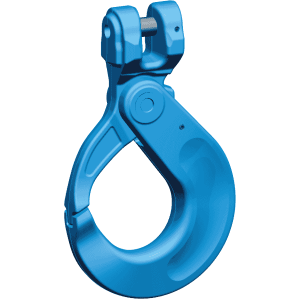
In high-capacity chain sling assemblies, compatibility between hook throat dimensions and connecting components can become a limiting factor. This is particularly evident when moving to higher-grade systems such as Grade 12 (G12), where increased Working Load Limits (WLL) are achieved without proportional increases in nominal hook diameter.
The pewag oversized self-locking hook is engineered specifically to address this challenge while incorporating additional safety-focused design features.
Why is the Hook Oversized?
The oversized configuration is directly linked to its G12 classification.
Grade 12 chain systems deliver higher lifting capacities compared to Grade 8 (G8) and Grade 10 (G10) systems of the same nominal diameter. However, this increased capacity means that standard hook geometries sized purely to suit chain diameter may not provide adequate throat opening to interface with connecting components such as lifting lugs, padeyes, or shackles designed around lower-grade systems.
To counteract this, the pewag oversized self-locking hook features an increased throat dimension relative to its chain diameter. This ensures:
- Compatibility with a wider range of connection points
- Proper seating without forcing or side loading
- Retention of full system WLL without compromise
- Reduced need to overspecify connecting hardware
The oversized design therefore resolves the geometric mismatch that can arise when higher-capacity chain systems are integrated into existing lifting infrastructure.
Recessed Trigger Mechanism
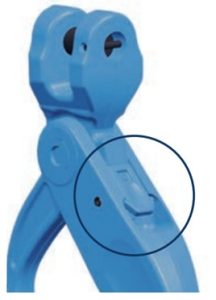
Unlike conventional self-locking hooks with exposed release triggers, the pewag design incorporates a recessed trigger integrated within the hook body profile.
This configuration:
- Minimises vulnerability to impact damage
- Reduces the risk of unintended actuation caused by contact with adjacent structures
- Protects the release mechanism when dragged or positioned on abrasive surfaces
For high-use lifting environments, this significantly reduces trigger deformation and premature component replacement.
Recessed Trigger Design
Anti-Unhooking Tip Geometry
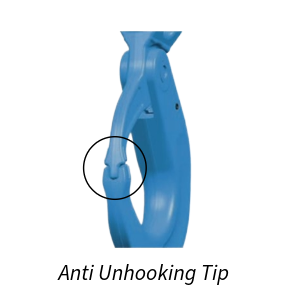
The hook tip geometry is engineered to reduce accidental disengagement under dynamic or imperfect loading conditions.
The profile improves retention when connecting to thinner lifting accessories or smaller-section connection points, while also increasing resistance to unintentional release caused by load shift or slack chain conditions.
Importantly, the geometry supports improved stability under non-ideal alignment without encouraging misuse outside prescribed loading parameters.
Integrated Wear and Deformation Indicators
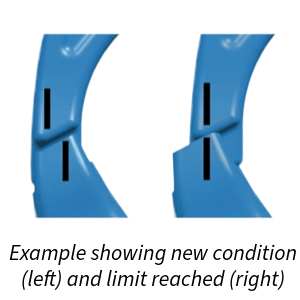
Inspection efficiency is enhanced through clearly defined deformation and wear limit indicators located on the hook tip.
These reference markings provide:
- Immediate visual confirmation of serviceability
- Clear identification when discard criteria have been reached
- Reduced inspection time during periodic examinations
Rather than relying solely on dimensional measurement, inspectors can quickly verify whether deformation limits have been exceeded.
Reduced Chain Wear at the Clevis
The clevis interface is designed with a raised profile to reduce concentrated wear at the final chain link.
This feature:
- Reduces abrasive contact between hook and chain
- Minimises localised wear at the connection point
- Extends overall sling assembly service life
For high-cycle lifting operations, protecting the terminal chain link is critical to maintaining assembly integrity.
Why Visual Condition Indicators Matter
Hooks can be subjected to damage without obvious failure. The integrated wear and deformation markings provide a clear, immediate indication of when limits are reached, allowing damaged components to be identified and removed from service. This visual reference simplifies inspection routines.
Typical Industry Applications
Hooks are commonly used for repeat lifting operations where speed and efficiency are important. Unlike shackles, which require pins to be removed and reinstalled for each lift, hooks allow loads to be quickly unhooked and reattached. This makes them particularly suitable for repetitive lifting tasks where downtime between lifts needs to be minimised.
Typical applications include:
- Construction
Repeated lifting and positioning of steel sections, precast concrete elements, formwork, and lifting frames during structural assembly. - Renewable Energy
Handling turbine components and sub-assemblies during manufacturing and installation, where multiple lifts of similar loads are required. - Offshore and Marine
Routine lifting of equipment, containers, hoses, and modules on decks, where frequent connection and disconnection is necessary. - Industrial Manufacturing
Repetitive movement of machinery parts, fabricated components, and production tooling between workstations. - Steel Fabrication and Engineering
Lifting beams, plates, and assemblies during fabrication, finishing, and loading operations. - Logistics and Material Handling
Regular lifting of frames, pallets, and handling equipment where fast rigging changes improve workflow efficiency.
Summary
The pewag Oversized Self-Locking Hook is designed to reduce the risks associated with accidental opening, unhooking, and undetected hook damage. By combining a recessed trigger, reinforced hook design, anti-unhooking tip design, and clear wear indicators, it supports safer lifting and more reliable equipment inspection.
When integrated into chain sling assemblies, these features help protect lifting accessories and reduce component wear.
To learn more about pewag oversized self-locking hooks or to get a quote, contact our sales team at [email protected] or call 01202 621511.