
News
Modulift Spreader Beam Supports Offshore Navigation Skid Lifting in the North Sea

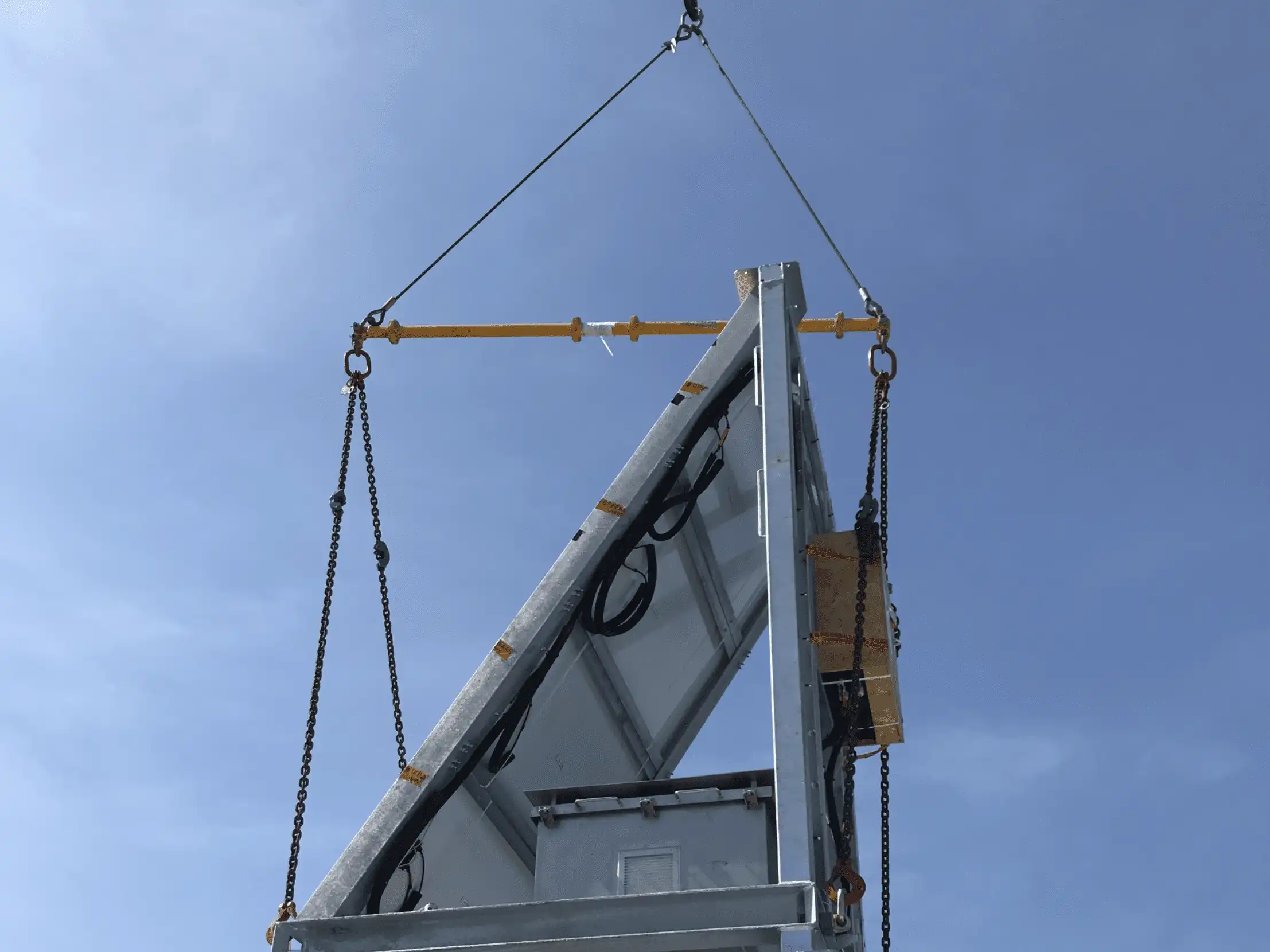
A Modulift spreader beam played a key role in the safe lifting and installation of offshore navigation skids used to mark decommissioned oil and gas platforms and offshore structures in the Dutch sector of the North Sea.
Working alongside Jansen Marine & Offshore Trading BV of the Netherlands, and U.S. headquartered Tideland Signal, the engineered lifting solution enabled navigation skids to be safely transferred from supply vessels onto offshore platforms and wind farm structures. The project highlighted the importance of carefully managing centre of gravity when lifting asymmetrical loads in challenging offshore environments.
The same lifting configuration has been successfully used across multiple offshore installations, demonstrating the versatility and reliability of modular spreader beam systems for marine and offshore applications.
Project Challenges in Offshore Navigation Skid Lifting
Offshore navigation skids are designed to provide temporary navigation and aviation warning systems for offshore structures that have been taken out of service but remain in place until decommissioning.
These skids present several lifting challenges due to their shape, weight distribution and large wind profile. While each skid weighs approximately 1.6 tonnes, the batteries are positioned towards the rear of the structure, shifting the centre of gravity away from the geometric centre.
The lifting eyes are also positioned low on the frame to provide maximum structural strength, making it even more important to achieve the correct lifting geometry and maintain stability throughout the lift.
Without careful engineering, these characteristics could result in an unstable load during lifting operations.
Equipment Used for the Project
To complete the offshore lifts safely, the project team utilised a 6-tonne Modulift spreader beam in combination with chain slings, wire rope slings and rotating attachment points capable of turning 360 degrees under load.
An extensive scope of work included provision of lifting equipment, which connected to the aforementioned Theipa Point TP-F attachment points with female threads, manufactured by JDT in Germany and sourced from distributor Jansen’s stock. Two-legged wire rope slings were supplied by Mennens Groningen for use above the spreader beam while beneath, two-legged chain slings from J.D. Theile completed the rig. The chain slings had shortening clutches and safety hooks on both sides of the skid, allowing for fine-tuning the length of the slings and positioning of the centre of gravity.
Robin Jansen’s father founded the original Jansen Marine Agencies in 1975. It became an agent for J.D. Theile in 1976 and remained so until 2011 when Jansen Marine & Offshore Trading BV was established and became a distributor.
This modular lifting arrangement enabled the navigation skids to be transferred safely from supply vessels onto offshore platforms before being lifted to the helideck and welded into their final positions.
Why a Spreader Beam Was the Right Solution
Lifting asymmetrical structures requires a configuration that can maintain balance while minimising unwanted movement during the lift.
The Modulift spreader beam was selected because it provided several important advantages:
- Improved load distribution
- Better control of the centre of gravity
- Increased lifting stability
- Flexible rigging adjustments
- Reduced load movement during lifting
- Adaptability for multiple offshore installations
The modular configuration also enabled the same lifting arrangement to be reused across several offshore platforms and one offshore wind jacket installation.
Managing Centre of Gravity During Offshore Lifts
One of the most important aspects of this project was controlling the centre of gravity throughout each lifting operation.
According to Robin Jansen, Managing Director of Jansen Marine & Offshore Trading BV, the large wind surface, asymmetrical design and low lifting eye positions created the potential for unstable lifting conditions.
By carefully adjusting the sling lengths beneath the spreader beam, the project team ensured the centre of gravity remained directly beneath the crane hook, significantly improving stability and reducing the risk of load rotation during lifting.
This engineered approach helped ensure each navigation skid could be positioned safely despite its challenging geometry.
Technical Lift Configuration Used on the Project
| Specification | Project Detail |
| Load | Offshore navigation skid |
| Approximate Load Weight | 1.6 tonnes |
| Skid Dimensions | Approximately 2m x 2m x 3m |
| Spreader Beam Capacity | 6 tonnes |
| Rigging | Wire rope slings and two-legged chain slings |
| Additional Equipment | Rotating attachment points with 360° movement |
| Offshore Partner | Jansen Marine & Offshore Trading BV |
| Rigging Partner | J.D. Theile |
| Navigation Equipment | Tideland Signal Ltd |
This lifting arrangement enabled offshore navigation skids to be safely installed on multiple offshore platforms and offshore wind structures throughout the North Sea.
Planning an Offshore Lifting Project?
Offshore lifting operations often involve complex load geometries, challenging environmental conditions and specialist equipment. From offshore platforms and navigation systems to wind farm infrastructure and marine structures, selecting the right lifting solution is essential for maintaining safety and operational efficiency.
Whether you’re lifting offshore equipment, marine structures or other specialised loads, Modulift’s engineering team can help identify the most effective below-the-hook solution for your project requirements.
Contact our team today to discuss your lifting application and discover how Modulift spreader beam systems can support safer and more efficient offshore lifting operations.